Case study — manufacturing & ecommerce
Henry Holsters
A mid-sized American holster manufacturer in Spencer, Indiana. I led the site rebuild and the systems work that connected its ERP, ecommerce and shipping platforms into one workflow.
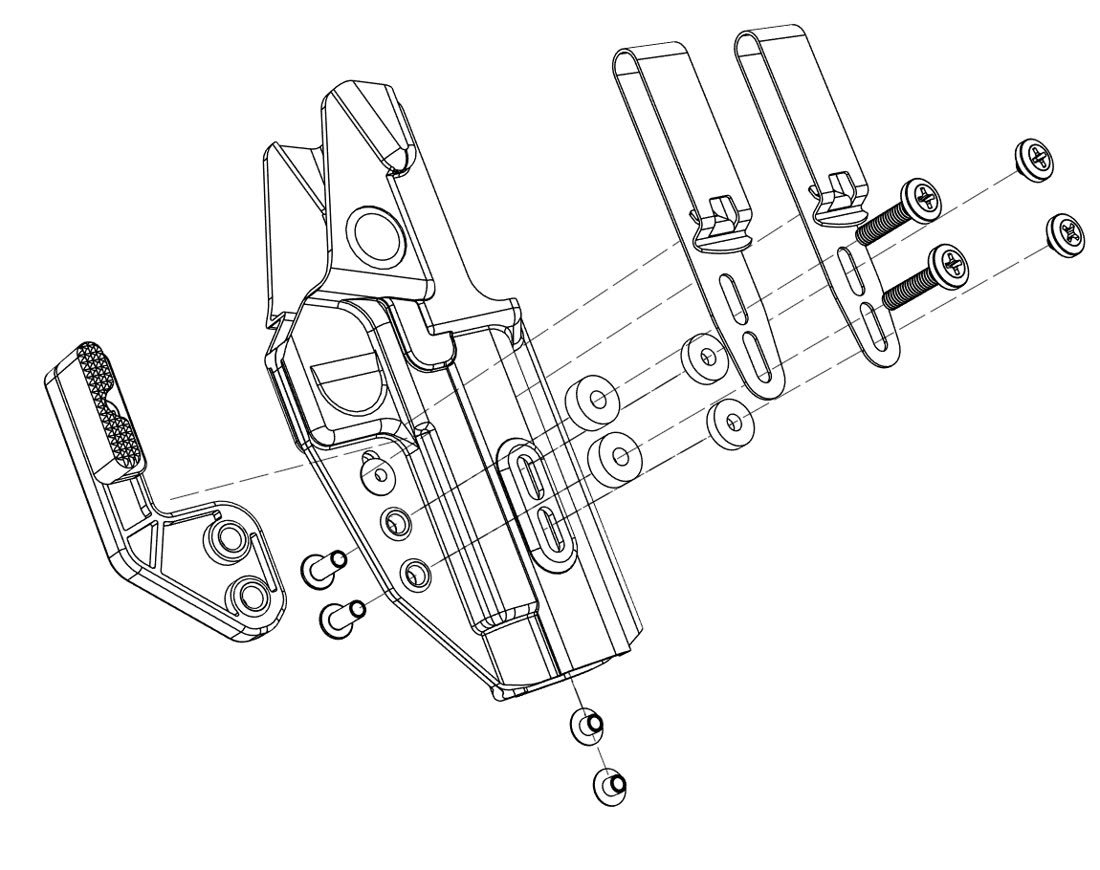
Scroll to assemble
The product
Built to a tolerance
Thirty parts and one thermoformed shell. Henry Holsters grew from a craft workshop into a name the concealed carry community trusts, and several of its thermoforming techniques and hardware choices became the industry’s default.
That precision is the reason the systems work mattered. A holster assembled to a thousandth is worth very little if the order behind it ships to the wrong address, or if the inventory count driving the build is three days stale.
So the brief was never only the storefront. It was the whole path — ERP to ecommerce to the label on the box — held to the same tolerance as the product.
The company
Henry Holsters is a mid-sized American holster manufacturer known for high-quality, precision-crafted concealment holsters. Founded in 2009 by Andrew Henry, the company grew from a small, craft-focused workshop into a respected name in the concealed carry community, with many of its thermoforming techniques and hardware innovations influencing the industry standard.
+32%
YoY direct sales growth
+$45,000
Sales growth
+130%
Average order value
Website redesign
The overhaul focused first on performance and technical efficiency. The new design reduced overall page weight, eliminated render-blocking assets, and streamlined template structure — resulting in page loads over 70% faster. Optimizing media delivery, simplifying DOM complexity and improving caching behaviour made the site fast and consistent across devices, which directly supports conversion by reducing friction at the first interaction.
The rebuild also treated SEO as structural rather than cosmetic. Page hierarchy was clarified, heading structure standardized, and internal linking strengthened to improve crawlability. Metadata was optimized across templates and content sections rebuilt to align with search intent, producing stronger keyword visibility and higher-quality organic traffic.
Checkout and the ecommerce experience were redesigned to remove friction at every step: simpler navigation paths, better product discovery, clearer product options, improved cart behaviour and better upsell recommendations.
+70%
Page load speed
+33%
SEO keyword ranking
System integrations
I continue to develop and implement a suite of integrations connecting the organization’s ERP, ecommerce and shipping platforms into a single operational workflow. Using a combination of Zapier-based automations and custom-built API applications, these integrations reduced manual processes, improved inventory accuracy, and delivered clearer, more reliable job costing and order visibility.
Fauxcrum
Fauxcrum 2.0 is a proprietary internal application built to provide faster access to high-value ERP functionality while improving inventory counts and synchronization across systems. It surfaces critical operational data in near real time, letting teams decide more quickly, reduce errors, and scale fulfillment with greater confidence.
Fulfillment
Shipster Pro
Shipster Pro is custom-built software created to improve the efficiency and accuracy of shipping operations. It introduced a one-click shipping workflow that significantly increased speed to ship while maintaining tight operational control.
The system improved order picking accuracy to 99.9% by enforcing verification at key steps and capturing a photo of every completed order, creating a reliable audit trail for quality assurance and customer support. Combining speed, accountability and traceability in a single workflow makes fulfillment measurably more dependable.
99.9%
Order accuracy
45,456
Orders shipped in 2025
AI workflows
My approach to AI is grounded in practical application and measurable impact, not experimentation for its own sake. I embed AI into existing systems — CRMs, marketing platforms, ecommerce tools, internal operations — to automate repetitive work, surface actionable insights and improve decisions without disrupting how teams actually operate.
That includes identifying trends in lead generation and buyer behaviour, enhancing attribution and forecasting, enriching and qualifying data, and proactively flagging opportunities or risks across the funnel. The goal is consistent: reduce friction, increase signal over noise, and give teams clearer insight they can act on at scale.
We use Social Intents, an OpenAI-powered customer support platform, as an AI customer service chatbot to handle common questions and recurring tasks automatically. Beyond the efficiency gain it has surfaced recurring customer pain points, informing further workflow and automation work.
Have a system that isn’t talking to the rest of the business?
That’s usually where I start. Tell me what’s breaking and I’ll tell you whether I can help.